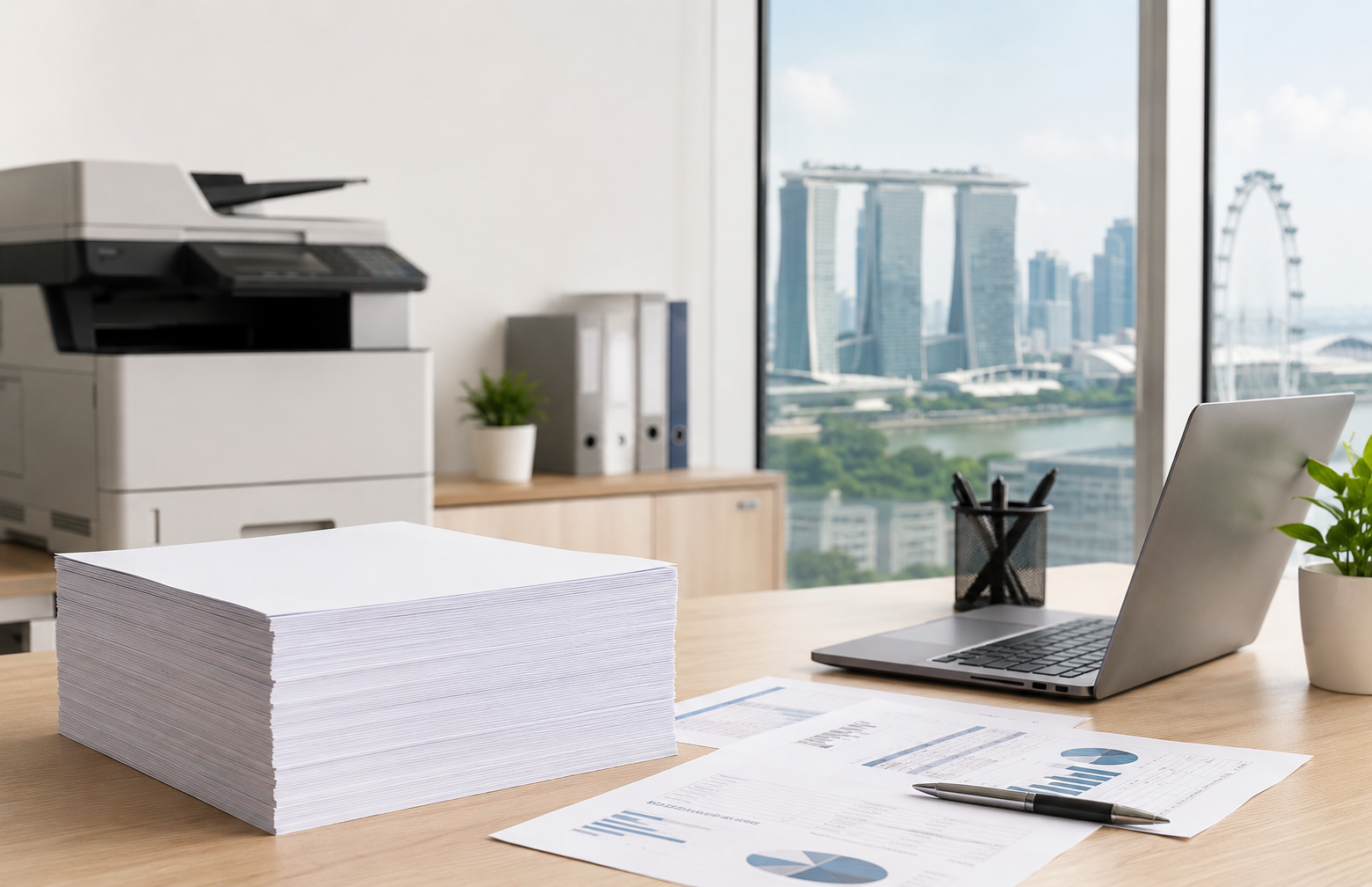
For businesses searching for copy paper Singapore options, the main priority is finding paper that works reliably for everyday office printing, photocopying and document handling.
Most offices use copy paper for routine documents such as forms, invoices, reports and internal records. This means the right paper should suit the office’s paper size, printer setup and daily document needs.
Businesses looking for suitable workplace paper formats may explore our copy paper and printing paper options for A4, A3 and A5 paper suitable for different office printing needs.
Table of Contents
- What Is Copy Paper Used For?
- Why A4 Copy Paper Is Common in Offices
- What to Consider Before Buying Copy Paper Singapore
- Choosing the Right GSM for Copy Paper
- Matching Copy Paper to Office Printing Needs
- Common Mistakes When Choosing Copy Paper
- Reliable Copy Paper Supply for Office Printing
- Final Thoughts
What Is Copy Paper Used For?

Copy paper is commonly used for everyday office printing, photocopying and document handling. In most workplaces, it supports routine documents that need to be printed clearly and handled regularly.
Typical copy paper uses include:
- invoices and receipts
- internal documents
- delivery orders
- forms and checklists
- meeting notes
- basic reports
- HR and finance records
- administrative paperwork
For most offices, copy paper does not need to be premium or specialised. It should be practical, printer-friendly and suitable for repeated daily use.
From a buying perspective, the main question is not only what copy paper is used for, but whether the paper matches the office’s document volume, printer requirements and preferred paper size.
For readers comparing paper terminology, our copy paper vs office paper comparison explains how different paper terms are used in everyday workplace printing.
Why A4 Copy Paper Is Common in Offices
A4 copy paper is the standard format used in most business environments. It fits common document types and works with most office printers and copiers.
For readers who want a clearer understanding of A4 dimensions and typical workplace applications, our A4 paper size guide explains why A4 remains one of the most commonly used paper formats for office documents.
Common A4 Copy Paper Uses
A4 copy paper is commonly used for:
- reports
- letters
- quotations
- invoices
- forms
- notices
- internal records
- general document printing
For businesses with regular printing needs, keeping a steady supply of A4 paper supplies helps reduce disruptions caused by sudden paper shortages.
When A3 or A5 Paper May Be Useful
Although A4 is the most common format, some offices may also use other sizes depending on their document needs.
For example:
- A3 paper for larger-format printing may be useful for charts, layouts or visual documents
- A5 paper for compact documents may be suitable for inserts, small forms or notes
Most businesses will rely mainly on A4 copy paper, while keeping A3 or A5 paper for more specific use cases.
What to Consider Before Buying Copy Paper Singapore
When buying copy paper Singapore businesses should consider more than whether the paper is available. The right choice depends on paper size, GSM, printer compatibility and how the paper will be used.
1. Paper Size
For most offices, A4 paper will cover the majority of printing needs. It is suitable for standard documents and is compatible with most office printers.
Businesses that regularly produce larger documents or compact printed materials may also need A3 or A5 paper, but A4 usually remains the core office format.
2. Paper Weight
Paper weight is measured in GSM and affects how copy paper feels, feeds through printers and performs during everyday use.
For general office printing, businesses commonly compare 70gsm and 80gsm paper. A lighter option may be suitable for routine internal documents, while a slightly heavier option may be preferred for documents that need firmer handling.
The best choice depends on print volume, document purpose and printer compatibility. Businesses comparing paper thickness in more detail may refer to our 70gsm vs 80gsm paper comparison guide for a clearer breakdown of how GSM affects office printing performance.
3. Printer Compatibility
Copy paper should feed smoothly through office printers and copiers. Paper that is unsuitable for the machine may increase the risk of jams, misfeeds or inconsistent output.
This is especially relevant for offices that print regularly throughout the day. Suitable copy paper should support steady printing without causing unnecessary delays.
4. Document Purpose
Not every document needs the same type of paper. Internal drafts, customer-facing documents and presentation copies may have different quality requirements.
A practical approach is to match the paper to the document instead of using the same paper for every situation.
Choosing the Right GSM for Copy Paper
For daily office use, 70gsm and 80gsm copy paper are common choices. Both can be suitable depending on the type of printing required.
70gsm Copy Paper
70gsm copy paper is often used for routine internal printing where volume and cost control matter.
It may be suitable for:
- drafts
- internal forms
- temporary documents
- high-volume printing
- general admin paperwork
80gsm Copy Paper
80gsm copy paper generally feels slightly thicker and may offer better handling for regular business documents.
It may be suitable for:
- invoices
- reports
- forms
- external documents
- presentation copies
- everyday business printing
The best choice depends on how the paper will be used. For many offices, 70gsm may be sufficient for internal documents, while 80gsm may be preferred for documents that need a firmer feel.
Matching Copy Paper to Office Printing Needs
A good copy paper choice should reflect daily office usage. This helps businesses avoid unnecessary waste while keeping documents suitable for their purpose.
For Internal Documents
Internal documents usually do not require premium paper. Standard copy paper is often sufficient for drafts, forms, notes and temporary paperwork.
For Customer-Facing Documents
Documents given to customers, clients or partners may benefit from slightly better paper handling. This does not always mean a premium option is needed, but paper consistency and GSM become more important.
For High-Volume Printing
Offices that print in higher volumes should prioritise paper that is reliable, easy to store and suitable for repeated printer use.
For businesses comparing broader procurement considerations, the office paper supplier Singapore guide explains what to look for when choosing a reliable paper supplier for recurring office needs.
Common Mistakes When Choosing Copy Paper
Even simple office paper choices can create issues when the paper does not match the way the business actually prints.
Choosing Copy Paper Without Checking Daily Usage
Some businesses choose copy paper without first considering how often it will be used. A small office with occasional printing may have different needs from a workplace that prints invoices, forms and reports throughout the day.
Before choosing paper, businesses should consider:
- how often paper is used
- whether printing is mostly internal or customer-facing
- which teams use the most paper
- whether A4 paper is the main format required
- whether paper needs to be reordered regularly
Ignoring Printer Compatibility
Copy paper should feed smoothly through office printers, copiers and multifunction machines. Paper that does not suit the printer may cause jams, misfeeds or inconsistent output.
This is especially important for offices that print regularly, as small paper issues can slow down daily operations.
Waiting Until Paper Runs Out
When paper is ordered only at the last minute, businesses may have fewer choices and less control over availability.
For offices that want to plan larger paper stocks more consistently, our bulk copy paper Singapore guide explains how businesses can plan copy paper supply by the box and reduce last-minute reordering.
Businesses comparing cost factors may also refer to our A4 paper price in Singapore guide, while organisations with recurring A4 usage can read our A4 paper wholesale in Singapore guide for broader supply planning considerations.
Reliable Copy Paper Supply for Office Printing

After reviewing copy paper Singapore buying considerations, the next step is to choose paper based on actual office use. For most workplaces, standard A4 copy paper is suitable for everyday printing, while higher-volume or customer-facing documents may require closer attention to GSM and paper consistency.
At WholesaleSupplies.sg, we support organisations with commonly used paper products suitable for everyday printing and administrative use.
Businesses sourcing paper for routine office use may explore our office printing paper options for commonly used workplace paper formats.
For offices that rely heavily on daily document printing, comparing available A4 paper supplies can help maintain a more consistent supply of standard office copy paper.
For smooth and dependable everyday document printing, organisations may also consider Mei Cheng A4 copy paper for routine operational needs.
Final Thoughts
Choosing copy paper Singapore businesses can use consistently is about more than selecting a basic office supply. The right paper should match daily printing needs, printer compatibility, document purpose and usage volume.
For most offices, A4 copy paper remains the main format for routine documents. Depending on business needs, organisations may also consider GSM, paper size and whether recurring purchases are more practical than last-minute ordering.
By reviewing paper size, paper weight and daily usage patterns, businesses can make better purchasing decisions and reduce unnecessary disruptions in office printing.
For paper supply enquiries, contact us via WhatsApp to check available stock, suitable paper options, bulk pricing and delivery details.